15 Kitchen Cabinet Organization Ideas
There is something about kitchen cabinets that makes clutter incredibly easy to ignore.
You close the door, and suddenly the problem does not exist.
Until, of course, you need the one baking dish that is underneath three other baking dishes, two muffin tins, and a pan you have not used since 2017.
Kitchen cabinets are one of those spaces that can look perfectly fine from the outside while absolute chaos is happening behind closed doors. And if your kitchen is short on storage space, keeping cabinets organized can feel even harder.
The good news is that you do not need a huge kitchen, custom cabinets, or hundreds of dollars worth of organizers to make your cabinets work better.
A few simple changes can make a surprisingly big difference.
These kitchen cabinet organization ideas are practical ways to use the space you already have, make everyday items easier to reach, and hopefully stop something from falling out every time you open a cabinet door.
Because that's really the goal here. Not perfection. Just a kitchen that works a little better.
1. Start by Getting Rid of What You Don't Use
I know. This is not the exciting organization hack you came here for.
But before you buy bins, shelf risers, or any other kitchen organizer, take a quick look at what is actually inside your cabinets.
Do you really need 14 coffee mugs?
What about the plastic container with no matching lid?
Or that random kitchen gadget you bought because you were definitely going to start making homemade something and then never did?
Small cabinets become much easier to organize when they are not holding things you never use.
You do not have to empty your entire kitchen at once. Start with one cabinet. Pull everything out, wipe down the shelf, and only put back the things you actually want.
You might be surprised by how much space you already have.
2. Add Shelf Risers to Double Your Storage
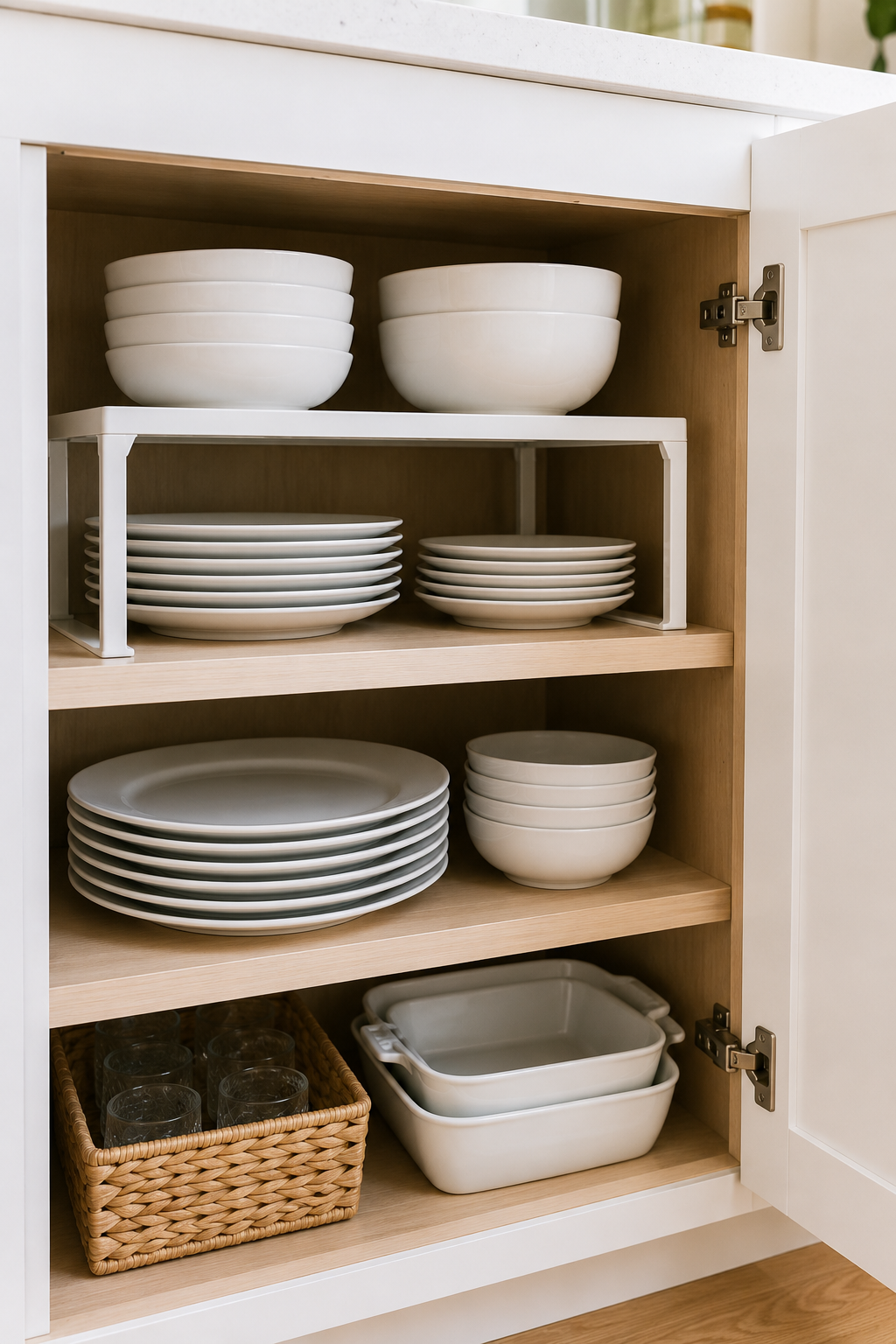
Shelf risers are one of my favorite kitchen cabinet organization ideas because they solve such an obvious problem.
Most kitchen cabinets have a ton of unused vertical space.
You might have plates sitting on the bottom of a shelf with eight inches of completely empty space above them.
A shelf riser essentially creates another level.
Use one to separate dinner plates from smaller plates and bowls, or add one to a cabinet filled with mugs and glasses.
They are also great for canned foods, baking supplies, or small appliances.
Instead of stacking everything into one giant tower that you have to dismantle every time you need something from the bottom, each category gets its own little shelf.
3. Use Clear Bins to Group Similar Items
Clear bins work just as well inside kitchen cabinets as they do in a pantry.
The trick is not to put everything you own into a bin.
Use them for the things that tend to become scattered.
You could create a bin for baking supplies, snacks, drink mixes, coffee supplies, food storage accessories, or small packets.
Being able to pull out an entire bin is especially helpful in deep cabinets.
Instead of reaching into the back and blindly feeling around for something, you can slide the whole container forward.
And because the bin is clear, you can actually see what's inside without having to label every single thing.
4. Install Pull-Out Drawers in Deep Cabinets
Deep lower cabinets can hold a lot of stuff.
Unfortunately, half of that stuff usually disappears into the back.
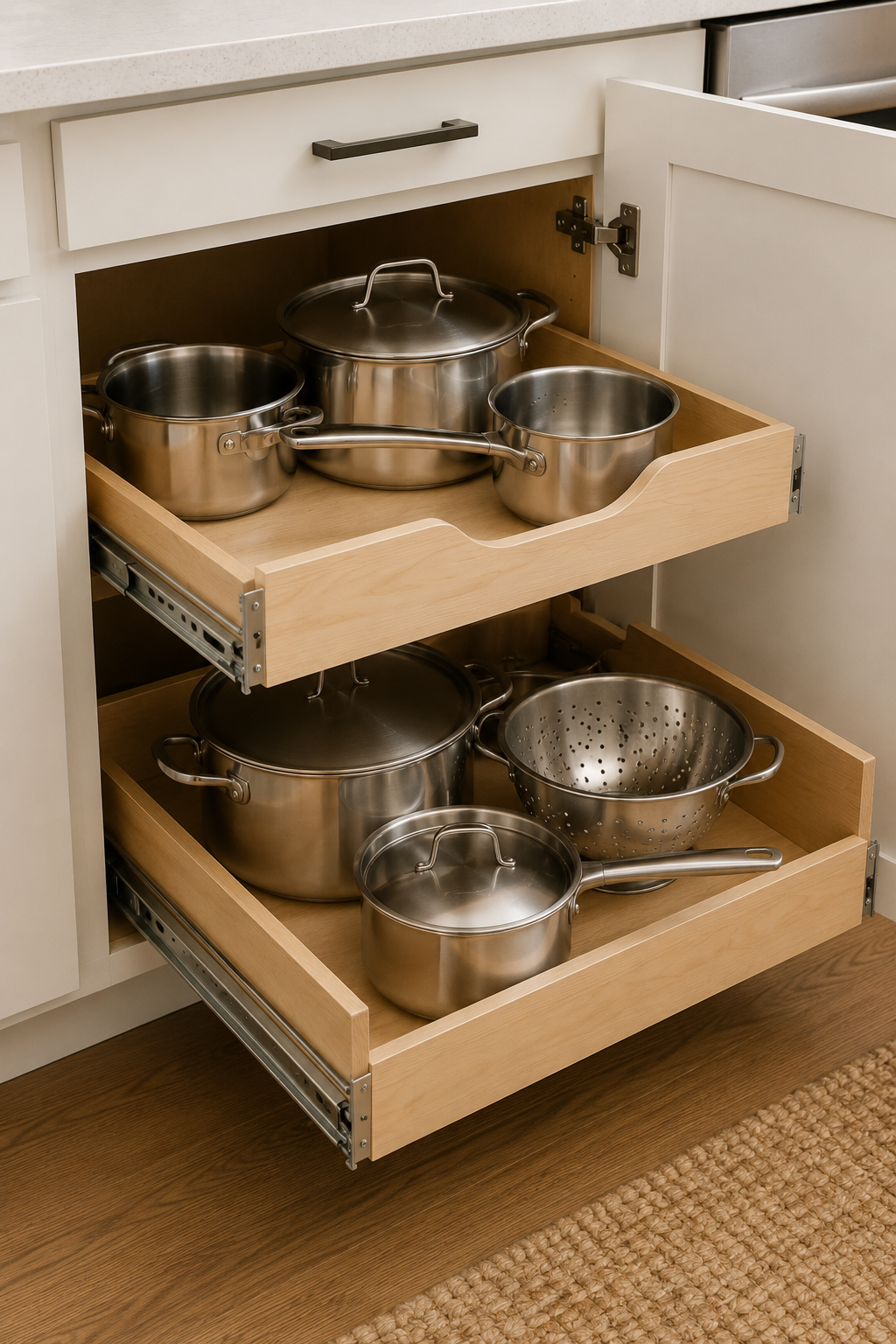
Pull-out cabinet drawers or sliding organizers can completely change how you use a deep cabinet.
Instead of kneeling on the kitchen floor and removing five things to reach the pot in the back, you simply slide the drawer toward you.
Use pull-out storage for pots and pans, mixing bowls, small appliances, food storage containers, or pantry items.
There are plenty of options that can be added to existing cabinets, so you do not necessarily need custom cabinetry.
This is one organization upgrade I would consider spending a little more on, especially for a cabinet that frustrates you every single day.
5. Store Pots and Pans Vertically
Stacking pots and pans seems logical until you need the one on the bottom.
Then suddenly you're playing a very loud game of kitchen Jenga.
A vertical organizer allows you to store pans on their sides instead.
This works particularly well for frying pans, skillets, cutting boards, and pot lids.
You can buy organizers designed specifically for this purpose, but even a sturdy file organizer can sometimes do the job.
Vertical storage uses cabinet space differently and makes it much easier to grab one item without rearranging everything else.
6. Give Food Storage Containers Their Own Cabinet
Food storage containers deserve their own organizational intervention.
I do not know what happens to all the lids, but I am convinced they are somehow related to the socks that disappear from the dryer.
If possible, dedicate one cabinet or drawer to food storage containers.
Nest containers by size rather than storing every container with its lid attached. Then keep the lids upright in a separate organizer or bin.
This takes up much less space and makes matching containers and lids easier.
And every once in a while, go through the collection.
If a container no longer has a lid, or a lid no longer has a container, it might be time to let it go.
7. Use the Inside of Cabinet Doors
Cabinet doors are another one of those spaces we tend to forget about.
Depending on the cabinet, you can add small racks, adhesive organizers, hooks, or slim storage containers to the inside of the door.
This can be a great spot for measuring spoons, pot lids, cutting boards, cleaning supplies, wraps, or other lightweight kitchen items.
Just make sure whatever you add is thin enough that the cabinet can still close properly.
Nothing ruins an organization project faster than realizing your beautifully organized cabinet will no longer shut.
8. Organize Baking Sheets and Cutting Boards Upright
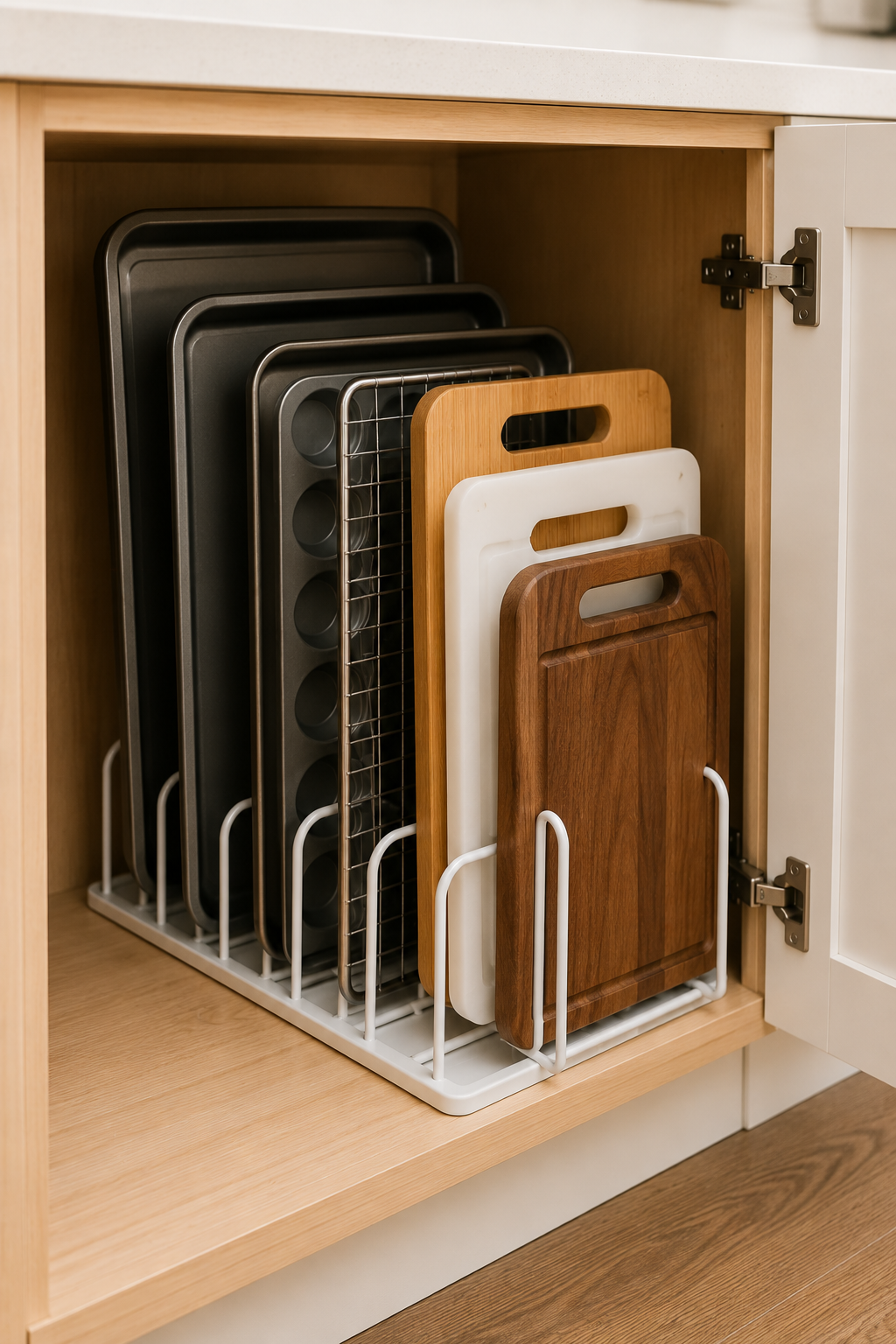
Baking sheets, muffin tins, cooling racks, and cutting boards are awkward.
Stack them flat and you inevitably need the one at the very bottom.
Instead, store them vertically.
You can use a bakeware organizer, tension rods, or dividers to create individual sections inside a cabinet.
Then slide each pan or cutting board into its own space.
This is one of those simple changes that makes you wonder why you spent years lifting an entire stack of baking sheets just to get one cutting board.
It also makes it much easier to put things away after washing them.
9. Create Zones Inside Your Kitchen Cabinets
Think about how you actually use your kitchen.
Your everyday dishes should probably live close to the dishwasher or sink. Coffee mugs make sense near the coffee maker. Baking supplies should be grouped together. Pots and pans are most convenient near the stove.
This is what creating kitchen zones is all about.
Instead of organizing based only on where something happens to fit, organize according to how you use it.
Your zones might include everyday dishes, baking, coffee, cooking, food storage, kids' items, and entertaining.
You do not need labels or a complicated system.
You just want things to live near the places where you actually use them.
10. Use Turntables for Oils, Sauces, and Small Jars
A Lazy Susan can be incredibly useful inside a kitchen cabinet, especially for small bottles and jars.
Use one for cooking oils, vinegars, sauces, spices, vitamins, or baking ingredients.
Instead of pulling out everything in the front to reach something in the back, just give the turntable a spin.
I particularly like this solution for upper cabinets that are slightly too deep to see everything clearly.
Just avoid putting too many things on it.
If the turntable is packed so tightly that nothing can actually turn, we have officially defeated the purpose.
11. Make Use of Under-Shelf Space
Sometimes the best kitchen storage space is hiding right in front of you.
If your cabinet shelves have a lot of empty space underneath them, consider an under-shelf basket.
These organizers slide onto an existing shelf and create a small storage area underneath.
They work well for lightweight items like kitchen towels, wraps, sandwich bags, coffee supplies, small plates, or even certain food items.
They are especially useful if you rent or do not want to permanently alter your cabinets.
No drilling. No major project. Just a little extra storage where there used to be empty space.
12. Keep Everyday Items Within Easy Reach
The things you use every single day should be the easiest things to reach.
It sounds ridiculously obvious, but our kitchens do not always reflect that.
We end up with holiday serving dishes taking up prime cabinet space while the cereal bowls everyone uses daily are crammed onto a high shelf.
Put your most frequently used dishes, glasses, cookware, and ingredients somewhere comfortable to reach.
Move rarely used items higher up or into less convenient cabinets.
This is particularly important when organizing a small kitchen because every cabinet needs to earn its keep.
Your kitchen should be organized for your actual life, not for the two times a year you use a giant turkey platter.
13. Use Baskets to Hide Visual Clutter
Not every kitchen cabinet needs to look like a perfectly styled magazine photo.
Sometimes you just need a basket.
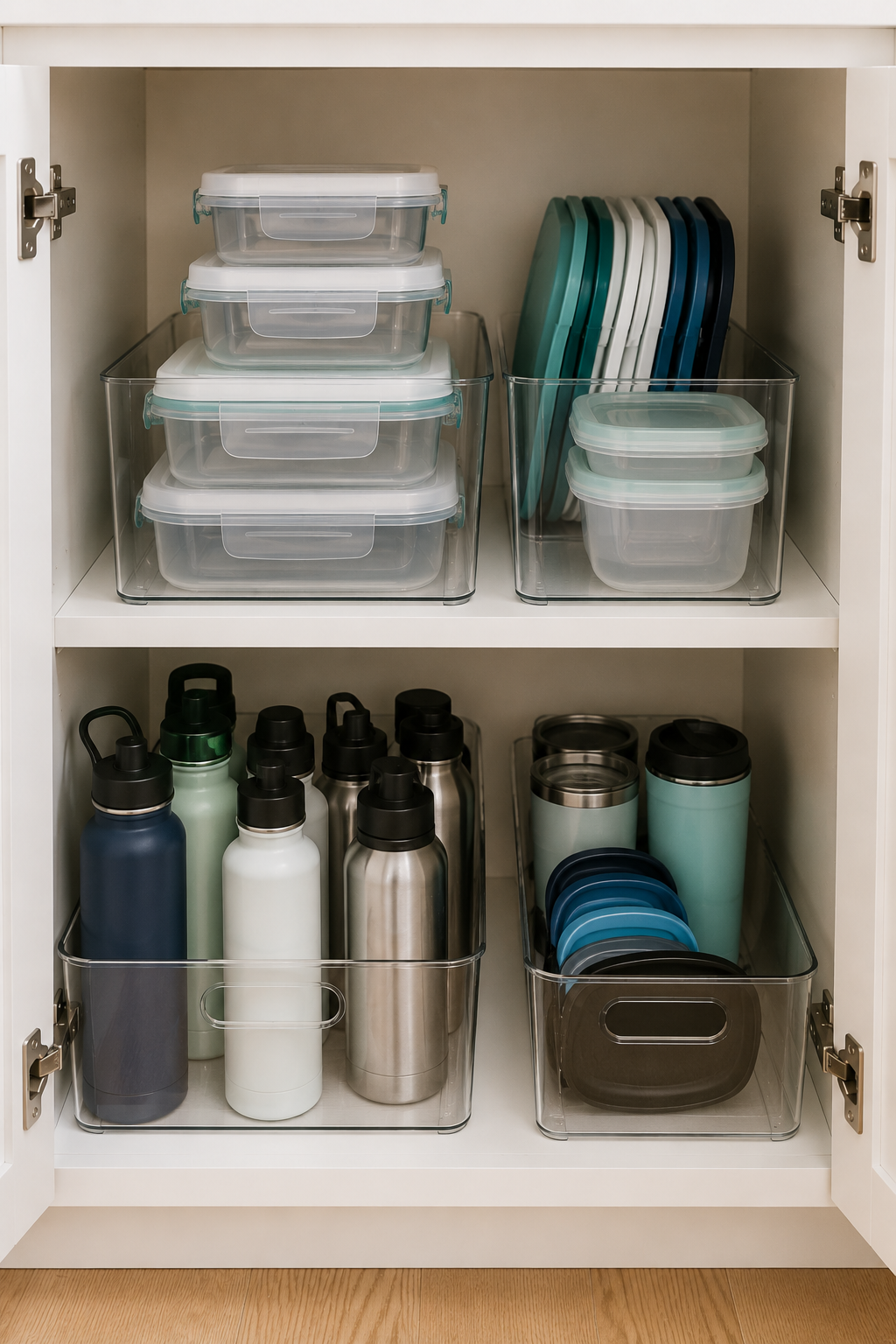
Baskets are great for grouping things that are useful but not particularly attractive or easy to organize individually.
Use them for reusable water bottles, kids' cups, lunch supplies, small appliances, dish towels, or miscellaneous kitchen accessories.
They are especially helpful in open cabinets or cabinets with glass doors because they reduce visual clutter.
And they make cleaning up easier.
Instead of carefully arranging 10 small items, you put them into one basket and move on with your day.
That is my kind of organization.
14. Add a Pot Lid Organizer
Pot lids are somehow both flat and impossible to store.
Stacking them usually results in a leaning tower of glass and metal that feels mildly dangerous every time you open the cabinet.
A pot lid organizer keeps lids upright and separated.
You can place one inside the cabinet, mount an organizer to the cabinet door, or use adjustable dividers.
The best option depends on your cabinet layout.
Whatever method you choose, the goal is to be able to grab one lid without every other lid coming with it.
Small victories.
15. Leave a Little Empty Space
This was one of my favorite tips for organizing a small pantry, and it is just as important for kitchen cabinet organization.
Do not try to fill every single inch.
When cabinets are completely packed, they are much harder to keep organized.
You buy one new water bottle and suddenly there is nowhere to put it. You unload the dishwasher and have to rearrange three shelves. You come home with groceries and start shoving things wherever they fit.
A little empty space gives your cabinets room to function.
You might even designate one small section as flexible storage so there is somewhere to put something new without reorganizing the entire kitchen.
The goal is not to see how much you can cram into your cabinets.
The goal is to make the things you actually use easy to find and easy to put away.
How to Organize Kitchen Cabinets Without Spending a Lot of Money
It is very easy to look at gorgeous organized kitchens online and think you need to buy an organizer for every cabinet.
You don't.
In fact, I would not buy anything until you've gone through the cabinet you're trying to organize.
Start by removing everything.
Get rid of things that are broken, expired, missing pieces, or simply never used.
Then group similar items together and put them back according to how frequently you use them.
Live with the new setup for a few days.
You may discover that the problem was not a lack of organizers at all. You simply had too much stuff or things were being stored in inconvenient places.
Once you identify an actual problem, then buy something that solves it.
For example, if your baking sheets keep falling over, buy a vertical divider. If cans disappear into the back of the cabinet, add a shelf riser. If your pots are impossible to reach, consider a pull-out drawer.
You can also repurpose organizers you already own. Small baskets, magazine holders, tension rods, file organizers, and even sturdy shoe boxes can sometimes work just as well as products specifically marketed for kitchen organization.
Organizing your kitchen does not have to become an expensive shopping trip disguised as decluttering.
How Do You Organize Kitchen Cabinets in a Small Kitchen?
When cabinet space is limited, focus less on fitting more into your cabinets and more on making the available space work harder.
Use vertical space with shelf risers. Store flat items upright. Take advantage of cabinet doors. Use pull-out storage in deep cabinets. Move rarely used items away from your prime storage areas.
Most importantly, be realistic about what deserves space in your kitchen.
If you have not used something in years, ask yourself whether it really needs to occupy valuable cabinet space.
You also do not have to organize your entire kitchen in one afternoon.
Honestly, I would rather tackle one cabinet at a time.
Choose the cabinet that annoys you the most.
Fix it.
Then move on to another one when you have time.
That feels much more manageable than pulling everything out of your kitchen and realizing two hours later that your countertops are covered in dishes and you've made a terrible mistake.
Create Kitchen Cabinets That Actually Stay Organized
The best kitchen cabinet organization ideas are not necessarily the ones that look the prettiest in pictures.
They're the ones you can actually maintain.
If putting something away requires removing a bin, opening another container, rearranging three things, and performing a small balancing act, eventually you are going to stop doing it.
Keep your system simple.
Put everyday things within reach. Group similar items together. Use organizers where they solve a specific problem. And leave yourself enough breathing room that putting things away does not become a chore.
You may not end up with perfectly styled kitchen cabinets.
But if you can open a cabinet, immediately find what you're looking for, and close it again without anything falling out?
I'd say we're doing pretty well.